The GreenBuilding Endorser Programme
The GreenBuilding Endorser Programme has been established to help the European Commission and the GreenBuilding National Contact Points to promote GreenBuilding to potential participants and to support already registered GreenBuilding participants in their efforts to reduce the energy consumption in their non-residential buildings. The GreenBuilding Endorser Programme is open to almost all interested parties from the building sector.
In particular, registrations are welcome from:
• Equipment manufacturers,
• Building contractors,
• Energy management and system design companies,
• Electric utilities and energy service companies,
• Energy equipment importers, distributors and vendors,
• National professional and trade associations.
To become a GreenBuilding Endorser, an organisation must have assisted at least one building owner in becoming a GreenBuilding Partner. Furthermore, it is expected that a GreenBuilding Endorser will undertake specific actions to support GreenBuilding, according to the requirements below. In return, the Endorser will get public acknowledgement for their efforts.
Though not entailing legally binding obligations, joining the Endorser Programme requires a commitment to the objectives of GreenBuilding. Joining proceeds through a registration whereby the company in question commits itself to fulfil the GreenBuilding Endorser Programme requirements. Endorsers may use the GreenBuilding logo, and their relevant activities and products may be included in the promotional and technical support material.
The list of GreenBuilding Programme Endorsers, including a description of their specific contribution to the GreenBuilding Programme, will be published widely (brochure, Internet etc.).
Organisations, that are interested in becoming a GreenBuilding Endorsers are also advised to consult the Endorser Guideline and the "Highlight GB Endorser".
Becoming a GreenBuilding Endorser
• Each Endorser shall appoint a person responsible for communications with the European Commission and the GreenBuilding National Contact Points.
• Each Endorser shall promote the GreenBuilding Programme and its goals. In particular each Endorser shall help the European Commission and the GreenBuilding National Contact Points to promote the GreenBuilding Programme and strategies for enhancing the energy efficiency in non-residential buildings to potential programme participants.
• Each Endorser shall lay out a specific plan of how to promote the GreenBuilding Programme and send it to the European Commission and the GreenBuilding National Contact Points within three months after receiving the acceptance letter, together with a short description of the company.
• Each Endorser shall have assisted at least one building owner in becoming a GreenBuilding Partner.
• Each Endorser shall provide the European Commission and the GreenBuilding National Contact Points with up-to-date non-confidential and commercially available information on its products, technologies and services relevant for the GreenBuilding Programme.
• Each Endorser shall educate its clients on the benefit of energy savings and of the GreenBuilding Programme.
• Endorsers can withdraw from the Programme at any time without penalty.
QUESTION
1) Who can become the Endorser
2) What are the minimum requirements to become Green Building Endorser
3) Do you think that green building procedures are common in Poland?
Monday, 25 January 2010


GREENBUILDING
The goal of substantially improving end-use energy efficiency and promoting the use of renewable energy sources is a key
component of the EU energy and environmental policies, The European Commission Directorate General Energy and
Transport contributes to this goal through a series of actions under the "Intelligent Energy - Europe" Programme. In addition,
given the large share of energy consumption in buildings and the large cost effective energy saving potential, special
attention has been dedicated to the building sector. The GreenBuilding Programme is one of these actions, aimed
specifically at private and public non-residential buildings.
The GreenBuilding Programme is a European Commission voluntary programme through which non-residential building
owners and occupiers, being private or public organisations, are aided in improving the energy efficiency and to introduce
renewable energy sources into their building stock. Any enterprise, company or organisation (hereinafter defined as
“organisation”) planning to contribute to the GreenBuilding Programme objectives can participate.
Organisations, which occupy on long term lease or own non-residential buildings, can acquire "Partner" status. Through the
GreenBuilding, Partners will receive:
• aid in defining and carrying out an Action Plan, to reduce energy related operating expenses, while maintaining or
improving the building comfort level, indoor air quality and the related services;
• public recognition for their contribution to achieving the objectives of the European Union's energy policy
By reducing energy use, companies contribute to:
· minimising environmental impact, and in particular reducing CO2 emissions;
· improving the competitiveness of European economy;
· reducing dependence on imported energy sources, thus improving the security of European energy
supplies.
An organisation wishing to join the GreenBuilding programme and to acquire GreenBuilding Partner status will proceed by
the following 4 step process.
1) Energy Audit of the organisation's building, which are selected to participate in the GreenBuilding programme
2) Formulation of an Action Plan, defining the scope and nature of the organisation's commitment.
3) Approval of the Action Plan by the Commission in consultation with the National Contact Point; Commission grants Partner
status to Organisation.
4) Execution of the Action Plan, report to the Commission and to the relevant National Contact Point.
A partner could also be a company with only new buildings or buildings already (and recently) refurbished.
The organisation's engineering and/or maintenance staff may be qualified to carry out the four steps of the GreenBuilding.
1) Energy Audit of Building(s).
The GreenBuilding Programme and the National Contact Points (will propose specific materials to aid the organisation in:
• establishing the energy use and the current state (hours of operation, climatic data, etc.) of the organisation's
building(s);
• evaluating the potential energy savings of building systems and equipment enhancements and replacement,
including the introduction of renewable energy sources.
The building audit is a mandatory step to start the GreenBuilding Programme participation. The building audit should identify
the major energy efficiency/savings opportunities, should prioritise them with regards to their cost-effectiveness and should
also indicate interactions between possible measures undertaken in different part of the buildings between insulation and
boiler sizing). If the organisation decides, following the whole building audit, to upgrade only a specific subsystem (i.e.
lighting, HVAC, etc.), then it is strongly encouraged to make a more detailed audit for the chosen subsystem to identify the
most important and cost-effective efficiency opportunities, as well possible interactions between different measures and/or
subsystems.
2) Formulation of an Action Plan to achieve energy savings On the basis of information collected in step 1, the organisation
decides on an Action Plan laying out the energy saving measures that correspond to the enterprise's criteria for profitable
investments. This plan must define the building or site at which energy efficiency and renewable energy actions will be
undertaken. The commitment has to apply to the building’s total energy consumption (electricity, WW and heating). The
organisation will identify, within the chosen building, the types of end-use equipment, systems, and/or services it chooses to
upgrade. The scope should in principle include the systems responsible for the major part of the energy consumption.
Partners are supposed to select more than one module.
Technical Modules):
• Building shell (insulation, windows, etc.);
• Lighting;
• Office equipment;
• Electric appliances (commercial refrigeration, washing, cooking, lifts etc.);
• Distribution transformers and UPS;
• Ventilation;
• Air-conditioning and passive cooling;
• Heating and water heating;
• Solar hot water and heating;
• Co and tri-generation;
• Energy management (mandatory module)
Organisations wishing to become GreenBuilding Partners will receive aid, advice and technical assistance from the
Commission and from participating National Contact Points in formulating and carrying out a building energy saving and
renewable "Action Plan". The GreenBuilding Programme focuses on non-residential buildings, for which it has been
demonstrated that large technical and economic potential for energy savings exist. By carrying out the Action Plan,
organisations will be able to:
• maintain or improve comfort levels, indoor quality and the quality of the service of the systems concerned;
• realise technically and economically feasible energy savings. The plan must satisfy the criterion of economic
efficiency, so that the allocation of scarce financial and human resources is justified from the viewpoint of the
organisations.
Furthermore, Partners will receive public recognition for their efforts, through theProgramme's promotion campaign, aimed at
raising public awareness of energy issues.
• Partners may use the GreenBuilding Programme logo. Partners may post signs, artwork of which is provided by the
European Commission, publicising their energy saving actions and the contribution they are making to the environment.
• The list of GreenBuilding Partners, including a description of their specific contribution to the Programme will be published
widely (brochure, Internet, etc.). The Commission will send the list of Partners to the national GreenBuilding representative
(see paragraph 4 below) and to the Member State representatives in the IEE Programme Committee.
• Partners will be invited to provide documentation of showcase buildings/systems that the European Commission can
publicise, providing details on baseline energy use, what was done, and the resulting energy use after the upgrade. The
European Commission will provide estimates of pollution prevented.
• The organisation's relevant activities may be included in GreenBuilding promotional activities, such as Awards and the
Catalogue.
• GreenBuilding Programme Awards will be made to outstanding GreenBuilding Partnerships in several categories.
Questions.
1) What company received green building certificate recently. A little help (building is located in Warsaw)
2) What are other energy saving certificates you can get.
3) Is it possible that already existing building can get a green building certificate? If yes what are rules.
4) How much energy you must save to become green building partner.
Thursday, 21 January 2010
CASINO ROULETTE
Hello everybody,
Today I would like to present you the famous game Roulette. This Casino game was first played in France in around the 17th century. Nowadays it is one of the most popular European but not only gambling game. The city Monte Carlo in Monaco is a well known and famous casino centre for playing roulette.
Basics
Usually there are up to eight players and they play against the House represented by the croupier sometimes House is called the dealer, who spins the roulette wheel and is responsible for the wagers and payouts. In the European roulette and French roulette version, the wheel has 37 slots representing 36 numbers and one zero but in the USA most roulette wheels have two zeros and therefore 38 slots.
Each player buys-in a different coloured chips so their bets don't get mixed up. At the end of play, if you won, you exchange back the colorued chips with cash chips. Each cash chip has its own amount printed on it.Those cash chips can be exchanged for real cash when you are leaving the Casino
To play roulette, you place your bet on numbers in the table layout or on the outside, and when everybody at the table had a chance to place their bets, the croupier starts the spin and launches the ball. Just a few moments before the ball is about to drop over the slots, the croupier says 'no more bets'. From that moment no one is allowed to place - or change - their bets. The winners are those bets that are on or around the number that comes up. Also the bets on the outside of the layout win if the winning number is represented.
Short video showing basic rules:
The payouts
A bet on one number only, called a straight-up bet, pays 35 to 1. (You collect 36. With no House advantage you should collect 37 (38 in the USA on double zero roulette wheels).
A two-number bet, called split bet, pays 17 to 1.
A three-number bet, called street bet, pays 11 to 1.
A four-number bet, called corner bet, pays 8 to 1.
A six-number bet, pays 5 to 1.
A bet on the outside dozen or column, pays 2 to 1.
A bet on the outside even money bets, pays 1 to 1.
Object of the game
To win at roulette the player needs to predict where the ball will land after each spin. This is by no means easy. In fact, luck plays an important part in this game. Some players go with the winning numbers calling them 'hot' numbers and therefore likely to come up more times. Others see which numbers did not come up for some time and bet on them believing that their turn is now due. Some players bet on many numbers to increase their chances of winning at every spin, but this way the payout is considerably reduced.
QUESTIONS!
1) Have you ever player Roulette?
2) Do you think that playing with friends the Roulette with small money is risky?
Today I would like to present you the famous game Roulette. This Casino game was first played in France in around the 17th century. Nowadays it is one of the most popular European but not only gambling game. The city Monte Carlo in Monaco is a well known and famous casino centre for playing roulette.
Basics
Usually there are up to eight players and they play against the House represented by the croupier sometimes House is called the dealer, who spins the roulette wheel and is responsible for the wagers and payouts. In the European roulette and French roulette version, the wheel has 37 slots representing 36 numbers and one zero but in the USA most roulette wheels have two zeros and therefore 38 slots.
Each player buys-in a different coloured chips so their bets don't get mixed up. At the end of play, if you won, you exchange back the colorued chips with cash chips. Each cash chip has its own amount printed on it.Those cash chips can be exchanged for real cash when you are leaving the Casino
To play roulette, you place your bet on numbers in the table layout or on the outside, and when everybody at the table had a chance to place their bets, the croupier starts the spin and launches the ball. Just a few moments before the ball is about to drop over the slots, the croupier says 'no more bets'. From that moment no one is allowed to place - or change - their bets. The winners are those bets that are on or around the number that comes up. Also the bets on the outside of the layout win if the winning number is represented.
Short video showing basic rules:
The payouts
A bet on one number only, called a straight-up bet, pays 35 to 1. (You collect 36. With no House advantage you should collect 37 (38 in the USA on double zero roulette wheels).
A two-number bet, called split bet, pays 17 to 1.
A three-number bet, called street bet, pays 11 to 1.
A four-number bet, called corner bet, pays 8 to 1.
A six-number bet, pays 5 to 1.
A bet on the outside dozen or column, pays 2 to 1.
A bet on the outside even money bets, pays 1 to 1.
Object of the game
To win at roulette the player needs to predict where the ball will land after each spin. This is by no means easy. In fact, luck plays an important part in this game. Some players go with the winning numbers calling them 'hot' numbers and therefore likely to come up more times. Others see which numbers did not come up for some time and bet on them believing that their turn is now due. Some players bet on many numbers to increase their chances of winning at every spin, but this way the payout is considerably reduced.
QUESTIONS!
1) Have you ever player Roulette?
2) Do you think that playing with friends the Roulette with small money is risky?
Friday, 15 January 2010
Tallest Buildings Part 2/3
Petronas Towers (452 meters)


With about 88 4-meter above the ground floors and 4 underground floors, the Petronas Towers is the tallest building in category highest to architectural top of the building.
Both towers have 76 elevators, 29 two-level elevators and 10 escalators are to transport people. The two towers at a height of 41 and 42 floors, which is at an altitude of 170 meters are connected by an external bridge 58,5 meters long.
7000 people worked in the construction of towers. 160 000 m³ of concrete, 77 000 m³ stainless steel were use to build the towers.
Sears Tower (443 meters)

2400 people worked in the construction of Sears Tower.
Sears Tower is a 443 meter high skyscraper and contains 110 floors. It has two television aerials 84 meters high each.
76,000 tons of steel were used to construct the skyscraper, this is sufficient to produce 52 000 vehicles. Installed telephone cables are about 80 000 kilometers long.
Building has 104 lifts and 18 escalators. Sears Tower is covered in black colored aluminum and has more than 16 100 windows. 1.5 million tourists visit the Sears Tower every year. At a height of 103 floor there is a observation deck.
Question:
Find some more buildings where Spiderman climbed on.
Wednesday, 13 January 2010
Tallest Buildings Part 1/3
Burj Dubai Burj Dubai has been called the tallest on the world before the end of the construction. It surpassed such constructions as the Petronas Towers (452 meters), the Sears Towers (442 meters), and the Taipei 101 (509 meters).
 Burj Dubai has been called the tallest on the world before the end of the construction. It surpassed such constructions as the Petronas Towers (452 meters), the Sears Towers (442 meters), and the Taipei 101 (509 meters).
Burj Dubai is the highest ever man made structure (the previous record belonged to the Radio mast in Konstantynów) thus it has in the four main categories recognized by “The Council on Tall Buildings and Urban Habitat” (CTBUH), which juxtapose and categorizes the highest buildings. The main categories recognized by CTBUH are:
- Height to architectural top of the building
- To highest occupied floor
- To tip of spire
- to top of the roof
Taipei
The entire structure contains 101 floors above ground and 5 floors underground. At 89 floor there is the internal observation room, the outdoor observation deck is located at 91 floor.
In 2004 its external observation deck was the second highest in the world, it was surpassed only by the Shanghai World Financial Center.
In 2004 the Taipei 101 owned 3 of the 4 titles of tallest buildings in the world:
- building with the highest structural point,
- to the of the roof
- the highest occupied floor.
Question to discuss:
Do you know any more tall buildings around the Word?
Sunday, 20 December 2009
The King Part 3/3
 Another interesting adventure in Presley life was becoming an actor. That is third and final part of my presentation. As it's impossible to pack a whole history into thre posts, if you still feel courious about Elvis (especially from late 60's and 70's) you can visit Wikipedia at http://pl.wikipedia.org/wiki/Elvis_Presley.
Presley first movie was "The Reno Brothers". Exclusively for this motion picture he recorder song "Love Me Tender". During the promotion of movie he performed it on very popular Ed Sullivan TV show. What's funny - cameramen were ordered to film Elvis from belt to heads in order not to scandalize audience with his pelvis dance. During that night show was watched by 54 million of Americans. Massive number of record orders pushed film company to change movie name to Love Me Tender. After noticing Presley potential and Love Me Tender success we got 7 year contract. He starred in typical romance movies that were full of colors, beautiful girls and such weak songs that even Elvis recorded them with disgust. Still he loved cinematography since youth when his favourite movie was City Across The River (1949) with Tony Curtis.
What's interesting Elvis first casting wasn't that successfull. Actually he was aware of not having an acting talent but Colones wanted very badly him to be a film star too. One reason is obvious - starring in movies was much less exhausting than performing live at concerts. But there is another theory - Tom "Colonel" Parker real name was Andreas Cornelies van Kuijk - illegal immigrant from Holland earning earlier by dabbling in many various things (hot dog seller or dogcatcher). That's would explain why Elvis never had a concert outside USA (in Europe or in Japan) although they had some attractive offers. Parket also didn't visit Presley during his army duty in Germiany.
Elvis hated TV because he was afraid of it and almost every time made out bad. That's why he preferred motion pictures - director was always there to help him, weak scenes could be replayed etc. Many times he was saying "I'd like to be a better actor". Spending hours on watching Marlon Brando and James Dean acting he was hoping to develop himself. Dean's sudden death created unfulfilled niche that Presley could utilize. Unfortunatelly he never dit it and Elvis never had a doubt about it - "I would have never compare myself with James Dean because he was a true genius... I thing I'am a weak actor but maybe with time I will learn something". Michael Curtiz ("Casablanca") who worked with him said he was very polite and hardworking having incredible memory for roles. Still Elvis wasn't best actor in the world.
In the end of 1956 Elvis was declared "King of Rock and Roll". Elvismania was at it's top and was going to be there for next decades about which proof hits like "Suspicious Minds", "In the ghetto", never published "We can make the morning" attached to this post. Hope you enjoyed this short presentation and learn something about Presley legend rising. Do you know any Presley songs? If you do - please list them in your comments.
The King Part 2/3
 Recorded on 1954 in Sun Records studio debutant single raved everyone. Once people discovered Elvis they wanted him to perform live at concerts.
Girls were going mad, boys wanted to look like him - their parents apparently couldn't stand his way of entertaining. They have forgiven him his black male
voice but that "animal expression" and "sexual tension" were too dramatic for traditional older generation to accept. What was interesting - Elvis was a very
shy person in private. Once he walked the stage he was changing to completely different person - the one that his young fans always dreamed of. Fame and
success were increasing day by day - his father once asked him - "What's going on, El? Yesterday I was working at can factory, and you were a truck driver".
 Next great breakthrough in Elvis career was meeting Thomas Andrew Parker called Colonel. Some say he was the manager of century but in fact he was rather sharpie harnessing Presley tremendous talent. He decided that best thing for his young star was hitting the nationvide market which effected in contract with
RCA Victor, which was the bigest american label. Sam Philips sold in this transaction right to Elvis for $ 35 000. Although it was a giddy amount of money back then, Elvis potential should be counted in millions, therefore Philips decision is inexplicable. Obviously it was his worst business deal of life.
 Parker had another idea for Elvis image. He urged him to become a great star and righteus citizen. First thing that was about to change was young singer
scandalous rebel performing. His idea was also trying Elvis luck in film industry. First occasion to realize new strategy occured when Presley received his
call to Army. Elvis was terrified because two years out in army meant a certain stage death. Parker on the other hand was convinced it is a right choice and
answering country's call of duty was going only to help him in further career. Colonel took necessary steps to promote Presley accession. For example ceremony of cutting his hair was assisted by a big group of journalists and photographers. Elvis was not only famous but also an examplary soldier. When his unit was sent to Germany it turned out he was famous also there. Everyday between 19:30 and 20:30 he signed authographs for german fans. On 1958 Christmas he recevied 370 000 postcards! What's more - people couldn't wait for his return to showbusiness.
After serving two years in army he came back to USA on March 3, 1960. Asked what are his next plans he answered that he was going to sing futher, play in movies and perform with Frank Sinatra himself. Sinatra offered $ 150 000 for two songs sang by Presley in his TV show. Parker's plan worked out pefectly - once for all he finished with rebel young Presley - giving in return a righteous citizen willing to help in many social actions.
Before Army episode he managed to record a massive hit - Love Me Tender. Curiosity - originally movie accompanied to this song was titled The Reno Brothers but after a song success 20th Century Fox decided to change it after the song title. On 1957 another legendary song was recorded - Jailhouse Rock. And others like King Creole or Don't | I beg you.
Have you known that Elvis was in army? And before that he already was a superstar? Now that's was interesting!
Eating habits 3/3
Today I will talk about the most disgusting dishes in the world. I' d like to show you some of them which I regard as the most interesting.
 Baby mice wine
Baby mice wine is a traditional Chinese and Korean “health tonic” .Supposedly it tastes like raw gasoline but I have never tasted. Little mice with eyes still closed, are dropped into a bottle of rice wine. What is important they are still alive. Dead mice don't give that special flavour. Some time ago when I had opportunity to drink original tequila with small worm I thought that it was disgusting but now when I look at it I really think that tequila must be really delicious.
Cooked dog
Dog meat is eaten in some countries for an example in China. Proper breeds of
 dogs are raised on farms and killed like a chickens for their meat. Apart from unique taste it is believed that dog's meat brings specific medicinal benefits. Cultural attitudes, legalities, and history regarding eating dog meat varies from country to country. There is little statistical information about consumption of dog meat due to general taboo in western countries.
 Hákar
 Hákarl is just fermented shark. This specific dish came from Iceland. It is shark which is cured with a particular fermentation process and keep to dry about 4-5 months. Hákarl has a very particular aroma-rich smell and taste, similar to very strong cheese like Gorgonzola. Hákarl is possibile to eat it in pubs or even to buy in Icelandic stores all year round. Fermented shark is eaten in all seasons. Although it is a traditional Island meal many of the inhabitants have never ate it.
 monkey’s brain
Eating this Chinese meal is just a insanity. Monkey transmitsa very dangerous disease. It may causes high risky Variant Creutzfeldt-Jakob disease and other similar brain diseases. In parts of China, the monkey’s brain is eaten raw. I heard  very likely an urban legend in which some time ago people ate monkeys’ brains from the head of alive animal.
Eating this Chinese meal is just a insanity. Monkey transmits
 very likely an urban legend in which some time ago people ate monkeys’ brains from the head of alive animal.
 I found a description: "The monkey’s head was supported by its neck in a bracket, two pieces of wood with a semicircular hole on each side such that when you put them together, they form a complete circle around the animal’s neck, allowing the head to be exposed above the plank. The hair around the head is smooth-shaved with a shaving razor. A small chisel and a hammer is used to quickly chisel a circle around the crown, and the top part of the skull is removed. A teaspoon is used to scoop up the brain, which is immediately eaten. This has to be done before the monkey dies".
Isn't it horrible?
“Three Squeaks”
This is the next traditional Chinese dish which contained something alive. The main ingredient of this dish are newly born mice. They are still hairless and barely able to open their eyes. It is generally served like nachos with some kind  of cold sauces. The reason why it is called “Three Squeaks” is disgusting. The name is due to the sounds made when this dish is preparing and eating. The first squeak is when the mouse is picked up with the chopsticks. The second is when the mouse is dipped into the sauce (temperature changes causing the squeak). The last one is when the mouse is put into the mouth and the temperature changes again.
Balut - Boiled egg
In Cambodia people love to eat duck-egg called balut. In fact it is not just an  egg. The way of preparing balut is to let the embryo inside the egg to develop until the bird inside is nearly ready to go out. When the embryo inside is ready, the egg is boiled and served with a bit of salt on top. It is really cruel method of preparing the most famous breakfast meal.
In the world there are thousands of disgusting dishes. I described only a few of them but I hope that you heard or even eat something interesting an you will share with us your experiences.
Thursday, 17 December 2009
EATING HABITS PART 2/3
Today I'd like to write a little bit about some ancient eating habits in France, Rome and England
France
In XVII'th century Louis XIV reigned in France. It is said that he was the most greedy king in the whole history of Europe. In fact this king simply loved to eat! He was begining his day by drinking only a cup of tea or a broth. It was really simple breakfast. While he was eating, his servants were waiting expectantly as the King gave the orders for a lunch. It was a routine morning ceremony. Lunch was called le Petit Couvert, what means "the Little Service". In fact it was just a name because this meal was like a daily festivity. During lunch the King was eating four different soups, a stuffed pheasant, a partridge, a chicken or a duck, a ham, a mutton, eggs and a plate full of pastries, fruits, and jams. It was simply a usual menu and the king devoured it all. While he was eating the royal doctor was always present to take care of his health.
The lunch was a huge ceremony which usually lasted several hours. Louis employed 498 people for tasting each dinner. All of them had a special name appropriate to their profession. Before the King ate something a proper person had tasted the food to check the taste. During the ceremony of eating the whole refectory was full of guests which were invited specially due to the lunch. Louis XIV didn't like to be distracted while he was eating, so he forbade all dinner conversations. The audience staied in absolute silence for many hours. After the King's death, doctors discovered that his stomach and intestines were twice the normal size.
Rome
Ancient Romans loved entertainments, feasts and mostly magnificent banquets. Rich Romans were spending fortunes on making feasts. They also were eating for many hours or even days. When they felt full and they couldn't eat anything more they just vomited to the special prepared bowl. Owing to it they could continue eating.
 Marcus Antonius loved boar's meat so much that his cook was roasting several pieces at the same time. Meat was in many different stages of preperation. The cook had to be ready all day in case of unexpected appetite of the master.
England
In XVII-XVIII century in England, habits and traditions of eating were similar to practices in France. The occupants of courts or rich country seats were spending their usual day on eating and, in fact, doing nothing. They ate very traditional meals such as cakes with whole pheasant inside, greasy hogs with apples and something absolutely special–cheese with swollen larvaes, called Casu marzu. It was a traditional delicacy which was served not only in inns during the long journey but also on courts. Worms preserved the cheese from a spoiling (this specific is still popular in Sardinia - I will talk a little bit more about this unusual cheese in my next presentation).
The most important English tradition is of course five o'clock tea. Tea appeared in England in 1658. The wife of king Charles II was organizing the meetings for women and served pastries and a tea. This custom became a national tradition not only for ladies.
Do you know any interesting eating traditions?
France
In XVII'th century Louis XIV reigned in France. It is said that he was the most greedy king in the whole history of Europe. In fact this king simply loved to eat! He was begining his day by drinking only a cup of tea or a broth. It was really simple breakfast. While he was eating, his servants were waiting expectantly as the King gave the orders for a lunch. It was a routine morning ceremony. Lunch was called le Petit Couvert, what means "the Little Service". In fact it was just a name because this meal was like a daily festivity. During lunch the King was eating four different soups, a stuffed pheasant, a partridge, a chicken or a duck, a ham, a mutton, eggs and a plate full of pastries, fruits, and jams. It was simply a usual menu and the king devoured it all. While he was eating the royal doctor was always present to take care of his health.
The lunch was a huge ceremony which usually lasted several hours. Louis employed 498 people for tasting each dinner. All of them had a special name appropriate to their profession. Before the King ate something a proper person had tasted the food to check the taste. During the ceremony of eating the whole refectory was full of guests which were invited specially due to the lunch. Louis XIV didn't like to be distracted while he was eating, so he forbade all dinner conversations. The audience staied in absolute silence for many hours. After the King's death, doctors discovered that his stomach and intestines were twice the normal size.
Rome
Ancient Romans loved entertainments, feasts and mostly magnificent banquets. Rich Romans were spending fortunes on making feasts. They also were eating for many hours or even days. When they felt full and they couldn't eat anything more they just vomited to the special prepared bowl. Owing to it they could continue eating.
 Marcus Antonius loved boar's meat so much that his cook was roasting several pieces at the same time. Meat was in many different stages of preperation. The cook had to be ready all day in case of unexpected appetite of the master.
England
In XVII-XVIII century in England, habits and traditions of eating were similar to practices in France. The occupants of courts or rich country seats were spending their usual day on eating and, in fact, doing nothing. They ate very traditional meals such as cakes with whole pheasant inside, greasy hogs with apples and something absolutely special–cheese with swollen larvaes, called Casu marzu. It was a traditional delicacy which was served not only in inns during the long journey but also on courts. Worms preserved the cheese from a spoiling (this specific is still popular in Sardinia - I will talk a little bit more about this unusual cheese in my next presentation).
The most important English tradition is of course five o'clock tea. Tea appeared in England in 1658. The wife of king Charles II was organizing the meetings for women and served pastries and a tea. This custom became a national tradition not only for ladies.
Do you know any interesting eating traditions?
The King Part 1/3
With my presentation I'd like to familiarize you with life and achievements of a true legend. The real king of popculture and music and a star who triumphed long before Michael Jackson. Of course I'm talking about Elvis Aaron Presley - king of a rock&roll.
At this point I must admit that I'm quite a novice fan of his talent because I discovered his music this year. Earlier he was just an icon that
I used to associate with characteristic hairstyle and sunglasses and wicked costumes. Back then I didn't understand why he was such popular.
Here and in 2 next posts I will bring you closer to really interesting parts of his life starting off with his career beginnings.
Actually there we have two Elvises in popculture - one whose image was born in mid-50's that is a handsome sex-bomb rebel and the second - chubbier with every year man
in colorful suites studded with jewelery and golden sunglasses.
 Elvis was born on January 8, 1935 in Tupelo (Missisipi). First curiosity - his mother gave birth to twins but unfortunatelly first boy was already dead. One after another - he's natural hair color was blonde! He coloured his hair since very young age that's why none of us would have a slightest idea that his hair color might differ from black.
Back to story - his parents were so poor that they couldn't even pay local doctor a mandatory $15 for birth receiving. After first twin death his mother was obsessed that
she'll loose second one so he was raised by an overprotective mother what surely had some influence on his personality. He wasn't allowed to swim, play sports or ride a bike -
such activities were way to dangerous in her opinion. Picture a mummy's boy spending all the time in house listening to radio - it's the King in the age of 10.
 On 11th birthday in 1946 instead of bike Elvis was longing for his parents bought him a guitar. Lucky for us. On 1948 Presley family moved to Memphis. That's where he
explored black blues and developed his very own music style mixed of country, gospel and others. Showbusiness got first in it's history white Black. Unlike his peers he
prefered to wear clothes in vibrant colors or having Ducktail haircut. Briefly until July 14, 1954 Elvis was dabbling in some easy jobs (e.g. truck driver) and trying to record his singles.
Cover of "That's All Right" originally by Arthur Cradup seemed to do the trick. Thanks to Sam Philips, it was aired in local radiostation and audience simply loved it. They called radio asking to play an Elvis song again. At the same time Elvis was in cinema watching a movie. His parents picked him up and took to the studio for a talk. He didn't know it was live.
Till november 1955 Elvis has been recording for Sun Records belonged to Sam Philips. Other famous musicians like Roy Orbison or Johnny Cash were working there at that time. Back then hits like
Mystery Train, I'm Left, You're Right, She's Gone", "Oakie Boogie" hit the market. On 1955 critics jocularly called Presley, Elvis the Pelvis over his characteristic vital (and erotic) dance at stage. Shocing older generation, he was idolised by teenagers. That's why FBI notes from 50's state that Elvis was potentially dangerous for United States.
Do you like Elvis Presley music? In next posts I'll embed his greatest songs that you probably like but never even realized they were his records.
At this point I must admit that I'm quite a novice fan of his talent because I discovered his music this year. Earlier he was just an icon that
I used to associate with characteristic hairstyle and sunglasses and wicked costumes. Back then I didn't understand why he was such popular.
Here and in 2 next posts I will bring you closer to really interesting parts of his life starting off with his career beginnings.
Actually there we have two Elvises in popculture - one whose image was born in mid-50's that is a handsome sex-bomb rebel and the second - chubbier with every year man
in colorful suites studded with jewelery and golden sunglasses.
 Elvis was born on January 8, 1935 in Tupelo (Missisipi). First curiosity - his mother gave birth to twins but unfortunatelly first boy was already dead. One after another - he's natural hair color was blonde! He coloured his hair since very young age that's why none of us would have a slightest idea that his hair color might differ from black.
she'll loose second one so he was raised by an overprotective mother what surely had some influence on his personality. He wasn't allowed to swim, play sports or ride a bike -
such activities were way to dangerous in her opinion. Picture a mummy's boy spending all the time in house listening to radio - it's the King in the age of 10.
 On 11th birthday in 1946 instead of bike Elvis was longing for his parents bought him a guitar. Lucky for us. On 1948 Presley family moved to Memphis. That's where he
explored black blues and developed his very own music style mixed of country, gospel and others. Showbusiness got first in it's history white Black. Unlike his peers he
prefered to wear clothes in vibrant colors or having Ducktail haircut. Briefly until July 14, 1954 Elvis was dabbling in some easy jobs (e.g. truck driver) and trying to record his singles.
Cover of "That's All Right" originally by Arthur Cradup seemed to do the trick. Thanks to Sam Philips, it was aired in local radiostation and audience simply loved it. They called radio asking to play an Elvis song again. At the same time Elvis was in cinema watching a movie. His parents picked him up and took to the studio for a talk. He didn't know it was live.
Till november 1955 Elvis has been recording for Sun Records belonged to Sam Philips. Other famous musicians like Roy Orbison or Johnny Cash were working there at that time. Back then hits like
Mystery Train, I'm Left, You're Right, She's Gone", "Oakie Boogie" hit the market. On 1955 critics jocularly called Presley, Elvis the Pelvis over his characteristic vital (and erotic) dance at stage. Shocing older generation, he was idolised by teenagers. That's why FBI notes from 50's state that Elvis was potentially dangerous for United States.
Do you like Elvis Presley music? In next posts I'll embed his greatest songs that you probably like but never even realized they were his records.
Ireland by my eyes - Belfast (North Ireland)
Ireland by my eyes - Belfast (North Ireland)
One of trips organized by International Society to Belfast was the biggest one. There was a full coach, so about 40 people.
As you well know, Belfast is in Northern Irnaldii, it is a separate country, subject to the United Kingdom. On the roads distances are in miles and you pay in pounds:)
I don't know how it's now, but in 2005 year, it was very specific city, because it was few years after civil war beetwen between Catholics and Protestants. There are remnants of the old wall, almost like in Berlin:) which divided the city into two parts. This can be seen by going to the traditional black taxi trip around the Belfast. On the buildings are painted portraits of Protestant liders and their other signs commemorating various events and fights.
 Trip by black Cab
 Wall
Wall
 Buildings on Protestants wall side
Is it normal that you see on the street, an armored police car like this:

There was one strange story, once we went out at the evening, walking through the city, we went dance to the a club. With us was a guy, all the time he was sitting in the corner, hi didn't say even any word, didn't dance, didn't drink a beer. After that, when we went out, somebody ask him why hi was so quiet, and hi answered that hi is from Southern Ireland, so if someone heard his accent, then he would be beaten. It was wery strange for me.
But in general Belfast is very beautiful City, amazing architecture, vibrant city.
 Belfast center
While in Belfast, we had a further trip to the amazing place. Did you hear about Giant's Causeway? This is one of the wonders of nature. It is an area of about 40,000 interlocking basalt columns, the result of an ancient volcanic eruption. The tops of the columns form stepping stones that lead from the cliff foot and disappear under the sea. Most of the columns are hexagonal, although there are also some with four, five, seven and eight sides. The tallest are about 12 metres high, and the solidified lava in the cliffs is 28 metres thick in places.


I have much more pictures, many beautiful, but unfortunately there is no enough place for them :(
One of trips organized by International Society to Belfast was the biggest one. There was a full coach, so about 40 people.
As you well know, Belfast is in Northern Irnaldii, it is a separate country, subject to the United Kingdom. On the roads distances are in miles and you pay in pounds:)
I don't know how it's now, but in 2005 year, it was very specific city, because it was few years after civil war beetwen between Catholics and Protestants. There are remnants of the old wall, almost like in Berlin:) which divided the city into two parts. This can be seen by going to the traditional black taxi trip around the Belfast. On the buildings are painted portraits of Protestant liders and their other signs commemorating various events and fights.
Is it normal that you see on the street, an armored police car like this:
There was one strange story, once we went out at the evening, walking through the city, we went dance to the a club. With us was a guy, all the time he was sitting in the corner, hi didn't say even any word, didn't dance, didn't drink a beer. After that, when we went out, somebody ask him why hi was so quiet, and hi answered that hi is from Southern Ireland, so if someone heard his accent, then he would be beaten. It was wery strange for me.
But in general Belfast is very beautiful City, amazing architecture, vibrant city.
While in Belfast, we had a further trip to the amazing place. Did you hear about Giant's Causeway? This is one of the wonders of nature. It is an area of about 40,000 interlocking basalt columns, the result of an ancient volcanic eruption. The tops of the columns form stepping stones that lead from the cliff foot and disappear under the sea. Most of the columns are hexagonal, although there are also some with four, five, seven and eight sides. The tallest are about 12 metres high, and the solidified lava in the cliffs is 28 metres thick in places.
I have much more pictures, many beautiful, but unfortunately there is no enough place for them :(
Ireland by my eyes - Dublin & Maynooth (East Ireland)
Ireland by my eyes - Dublin & Maynooth (East Ireland)
The University where I was studying is placed in Maynooth, it's mostly student small village near Dublin(capital of Ireland), about 20 kilometers, 40 minutes by train or bus. Buses are of course two-storey :) Almost whole life there is beacuse of student, there are 3 hipermarkets, Tesco, Aldi and DunniesDunnes Stores, so there is many possibilities to cheap shopping.
 Map of Maynooth
 Main street in
 Buses in Dublin
In Ireland it is typical, that there are many pubs and lounges. Some of them are realy huge, like many rooms, many floors, several bars. The biggest Pub in Maynooth is The Roost, it is also the most popular, every day, every night it was full, even there were queues in front of it.


Roost
 Roost inside
In Dublin is quite the same, in the city center down the streets there are many pubs, all day they are full of people, it is even hard to get in to the pub, because for example the most popular and the most known Pub in Dublin, Temple Bar, is quite Small, I mean thin corridors, you must to squeeze through the people if you want to buy a pint of beer.
 Temple Bar
 Dublin at night
Ok as I came to Beer, it is the most popular alcoholic beverage, every one drink beer, ale the day :) And of course Ireland has its own traditional beer Guinness. The oldest factory producing this beer up to now is placed near the center. In old part of the factory, now is Guinness museum, where you can learn how beer was made, you can lear how to pure guinness beer and get the certificate that you can do it, as pouring the beer must be in a special way, because Guinness is a Draught beer, it is special dark and thick type of beer, pouring is complicated, you need to do a special order resulting foam had an adequate thickness and must be convex and protruding from the pint. The taste is also completely different than beer we know. It took me about one month to get used to it and after come back to Poland I miss that.
 Perfect pint of Guinness
There buildings there are beautiful, many old building in very good condition, many parks, many palaces, castels and properties. It is realy amazing, of dazzling beauty like that building of Maynooth University, it is like from Harry Potter Movie, exactly, it is breathtaking, there are beautiful gardens nurtured every day.
 Dublin
 Park in the center of Dublin
Form Dublin it is few minuts to get to Sea, it is quite different coast than we have in Poland.
Practically there is no beach, the rocks are in most cases.
 Sea
Sea
Do you remember tv advert of Dog in The Fog beer? in fact it is a english beer, but it is not the point, I mean about the weather. Yes, there may be a little exaggerated, but in reality it is almost the same, realy strong winds, at least for half a week's rain.
The University where I was studying is placed in Maynooth, it's mostly student small village near Dublin(capital of Ireland), about 20 kilometers, 40 minutes by train or bus. Buses are of course two-storey :) Almost whole life there is beacuse of student, there are 3 hipermarkets, Tesco, Aldi and DunniesDunnes Stores, so there is many possibilities to cheap shopping.
In Ireland it is typical, that there are many pubs and lounges. Some of them are realy huge, like many rooms, many floors, several bars. The biggest Pub in Maynooth is The Roost, it is also the most popular, every day, every night it was full, even there were queues in front of it.
Roost
In Dublin is quite the same, in the city center down the streets there are many pubs, all day they are full of people, it is even hard to get in to the pub, because for example the most popular and the most known Pub in Dublin, Temple Bar, is quite Small, I mean thin corridors, you must to squeeze through the people if you want to buy a pint of beer.
Ok as I came to Beer, it is the most popular alcoholic beverage, every one drink beer, ale the day :) And of course Ireland has its own traditional beer Guinness. The oldest factory producing this beer up to now is placed near the center. In old part of the factory, now is Guinness museum, where you can learn how beer was made, you can lear how to pure guinness beer and get the certificate that you can do it, as pouring the beer must be in a special way, because Guinness is a Draught beer, it is special dark and thick type of beer, pouring is complicated, you need to do a special order resulting foam had an adequate thickness and must be convex and protruding from the pint. The taste is also completely different than beer we know. It took me about one month to get used to it and after come back to Poland I miss that.
There buildings there are beautiful, many old building in very good condition, many parks, many palaces, castels and properties. It is realy amazing, of dazzling beauty like that building of Maynooth University, it is like from Harry Potter Movie, exactly, it is breathtaking, there are beautiful gardens nurtured every day.
Form Dublin it is few minuts to get to Sea, it is quite different coast than we have in Poland.
Practically there is no beach, the rocks are in most cases.
Do you remember tv advert of Dog in The Fog beer? in fact it is a english beer, but it is not the point, I mean about the weather. Yes, there may be a little exaggerated, but in reality it is almost the same, realy strong winds, at least for half a week's rain.
Wednesday, 16 December 2009
EATING HABITS PART 1/3

Hello everyone! Today I invite all of you to read my blog. As you see it is connected with food habits.
Nowadays a "food" has became very popular and trendy. Television is full of programs about cooking in which stars and celebrities are showing how they love it. Everybody is also aware to food influence on our health and mood. We're trying to care about our health and change bad eating habits. But in fact, even if it is obvious we can meet some public activity absolutely opposite to it. It is surprising mainly due to the fact that it concerns highly developed, west country. England is the hero of my today's topic. The fact that Englishmen love eating is so evident and known that it 's starting to be their national feature. Often England is perceived as a country of extremely fat people. A British eating habits are very specific. Their cuisine is full of overcooked vegetables, greasy meats and sausages, snacks and sandwiches. In Britain there are a lot of bars and pubs which serve meals at very good prices. Unfortunately low price usually means low quality. Supermarkets offer wide assortment of ready-made meals which just must be put to microwave oven. The amount of this kind of meals on the market shelf is just incredible. Even though their eating habits are not proper they have great chefs and plenty of cooking programs. But meals which are served in English primary schools seem to be a horror. It is incredible that in advanced society nobody cares what children eat. The usual dinner contains everything what they shouldn't eat: hamburgers, chips, sweet drinks and as a dessert high-sugar sweets or crisps. No vegetables, no fruit — only one colour on the plate. I know that it sounds as exaggeration or nonsense but in fact it is true.
One of the famous British chefs, Jamie Oliver has started the campaign to raise the quality of food in British schools and transform the way the pupils eat. In 2004, he was shocked by the food that 8 millions British school children were being fed every day of the school year, Jamie took over the kitchens at the school in Greenwich.
He has transformed the recipes, has teached the cooks and organised the educational meeting with parents and children. At school he used shocking therapy on pupils and showed them how unhealthy a food looks after digestion. Before that all of them had been preparing their own meals which contained fresh vegetables, fruits, meat, etc. It was a good idea because of the fun and enjoyment of doing it.
Firstly children didn't want to change their old food but after some time they tried pasta, baked chicken, salad, boiled carrots and other colourful meals and stopped grumble. In interview one of the children confessed that it was the first time he tasted a lettuce. Isn't it strange?
Cooperation with children was a huge success however there were also a lot of problems. At some school children had to be taught how to use a knife and fork and in another pupils preferred to go to the local shop at lunchtime. Surprisingly parents were against Jamie's idea. Many of them preffered to make some packed lunch for their children. Guess what was inside?! It really sounds like a joke but they truly put there crisps, sweets, sandwiches made of white, artificial bread and many different products which are generally inadvisable for children. Others said that if their children didn't want to eat it was better to give them anything than nothing. There was also another serious obstacle — the government. After recognition of the problem and calculation of expenses they considered the Jamie Oliver's school dinner revolution as too expensive. So Jamie transformed his recipes and menues again, changed some of the ingredients but it still occured to be unacceptable. It was impossible to prepare better food at the same price. After a long and tough fight finally he managed to persuade the government to give some extra money. Government announced that it would pour an extra million pounds into school lunches over the next three years. The success of Oliver's campaign has transformed him from a celebrity to a popular hero.
Have you got any experience connected with English food ?
Did you see similar situations in other countries?
Ireland by my eyes
Ireland by my eyes - How it happened
4 years ago I have managed to leave on a scholarship student exchange (Socrates / Erasmus). It was Ireland. I was very excited, but I knew it would be my biggest adventure. And it was:)
Ok it was just a little intro, and I would like to divide my presentation into several parts.
1. Studying abroad
2. Dublin & Maynooth (East Ireland)
3. Belfast (North Ireland)
4. Galway (West Ireland)
In the first part I'll tell you how the life looks there, a little bit of study and generally about Ireland. In other parts I'll focus on why it is worthwhile to go there and I'll show what I have seen and photographed personally. So here is no images from the Internet, but either my or my friends:)
Ireland by my eyes - Studying abroad
As you know, on the green island people drive on the left, but compared to this, the rest of the differences is equally large. People has completely different mentality, everyone is friendly and smiles walking the street. People do not live in a rush. Everyone can help. You don't have to afraid go out on evening or night on the street.
 Always green and beautiful Ireland, even in December
Standard of studying it is quite different in the curriculum and the organisation. Educational standards are shockingly low compared to ours. In the fact that they begin to study 2 years earlier. Me and 2 other friends from PJWSTK, we didn't spent a lot of time for learning, despite the fact we were best in group, we brought back almost only "5" marks :)
Quality of life of students is on the contrary, much higher than us. There was a huge campus, residential villas / small block buildings divided into apartments for 5 people. Everyone has its own room, 2 common bathrooms per apartment and common room with kitchen. In newer buildings, each room has its own bathroom, just like in hotel:)
 Student's villages
 Maynooth University, The oldest University in Ireland
 New part of the Campus
International Society is very active, was organized various events, trips that I'll present in the subsequent parts of my presentation, parties, sport activities and entertainments.
In that moment, there were about 250 international students, so it is quite large amount. There was many abilities to integrate with each other.
 Student parties
I could say, that I could live there, there is different and better life. But I were there only for one semester, I missed my family and friend. I said to myself, that I have to back there in the future, maybe for the rest of my life :)
Any questions?
4 years ago I have managed to leave on a scholarship student exchange (Socrates / Erasmus). It was Ireland. I was very excited, but I knew it would be my biggest adventure. And it was:)
Ok it was just a little intro, and I would like to divide my presentation into several parts.
1. Studying abroad
2. Dublin & Maynooth (East Ireland)
3. Belfast (North Ireland)
4. Galway (West Ireland)
In the first part I'll tell you how the life looks there, a little bit of study and generally about Ireland. In other parts I'll focus on why it is worthwhile to go there and I'll show what I have seen and photographed personally. So here is no images from the Internet, but either my or my friends:)
Ireland by my eyes - Studying abroad
As you know, on the green island people drive on the left, but compared to this, the rest of the differences is equally large. People has completely different mentality, everyone is friendly and smiles walking the street. People do not live in a rush. Everyone can help. You don't have to afraid go out on evening or night on the street.
Standard of studying it is quite different in the curriculum and the organisation. Educational standards are shockingly low compared to ours. In the fact that they begin to study 2 years earlier. Me and 2 other friends from PJWSTK, we didn't spent a lot of time for learning, despite the fact we were best in group, we brought back almost only "5" marks :)
Quality of life of students is on the contrary, much higher than us. There was a huge campus, residential villas / small block buildings divided into apartments for 5 people. Everyone has its own room, 2 common bathrooms per apartment and common room with kitchen. In newer buildings, each room has its own bathroom, just like in hotel:)
International Society is very active, was organized various events, trips that I'll present in the subsequent parts of my presentation, parties, sport activities and entertainments.
In that moment, there were about 250 international students, so it is quite large amount. There was many abilities to integrate with each other.
I could say, that I could live there, there is different and better life. But I were there only for one semester, I missed my family and friend. I said to myself, that I have to back there in the future, maybe for the rest of my life :)
Any questions?
Saturday, 12 December 2009
UNCONVENTIONAL ACTIONS IN PUBLIC SPACES VOL.3
In third part I want to show you some unconventional actions concerning somewhat other sphere which has taken a lot from art based works—it's an advertisement. People are tired of ubiquitous colourful ads in ordinary forms such as billboards, posters, leaflets and importunate displays with annoying dynamic ads. It makes us more and more resistant to marketing actions.
 More, bigger... more effective?
That's why marketers had to figure out something to deceive our ad alertness—they started to use uncommon forms of advertisement what is called ambient marketing. But not the big agencies invented it–they provoked it to happen. Owners of small and middle business companies want to stay competitive but don't have money for common advertisement that would distinguish them. Instead of it they have much more–creativity and courage! Using both they have created "Guerilla marketing". Main base of it was an idea.
 Not money but idea matters...
It's ofcourse about piano lessons
Classic example of its beginnings is the action of middle town mechanic who was going to every sport event in the city and whenever audience was expressing their joy he was throwing up in the air his little business cards instead of confetti. After the success he changed his marketing strategy for more sublimated.It's an essence of Guerilla marketing but it gained huge attention not till then it was practised in big cities. That's because of easy access to mass-media and highly developed communication which gave it an extra kick. The good and effective idea spreads in twinkling of an eye over the country. And that is what "big advertisement" likes. So when huge money has come up, the scale and effectiveness of such ads have rapidly increased but, luckily, they have kept their creativity. One more thing has drastically changed—exposure of logos and trademarks. That's finally how "Ambient marketing" has come into existence.
To clarify: Guerilla marketing pretends that it's not an advertisement, it teases then at the end it occurs to be an ad.
Ambient marketing is recognised as an ad from beginning but it should be done in a curious, unusual way. Both are based on viral or buzz marketing (by MMS'es, e-mail, youTube or just by words of mouth)–the wider it spreads out the better.
In our country it isn't yet a custom to advertise in such way but we have something to show of.
The loudest action was promotion of Jelfa's cure for hangover. It was very organised campaign. At first agency registered character of prof. Mikolaj Onowalov on Wikipedia. They also publicised movies from his research of the "magic pill" called "Spectab" which was tested on soviet soldiers.
After that they set monument of great scientist on Warsaw's Plac Bankowy (actually it was staying on the truck which was apparently broken). It was enough to cause a storm in the media. Organisers has only just revealed what was going on after few days when interest was at the peak.
Below I attach images from some interesting actions over the world.
 This ad preety directly shows effects of global warming:)
 This example shows that not only artists know how to use opportunities in urban space:
 Ravensburger Puzzle ambient advertisement.
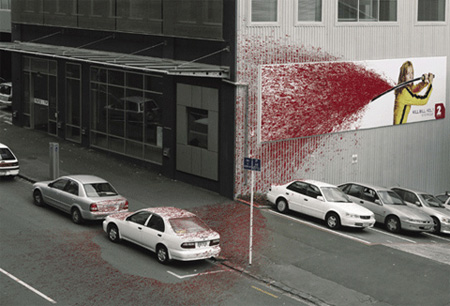 Kill Bill coming soon:)
 It is like with the public art—it doesn't have to be done with pomp to gain attention, idea is a priority: Vijay Sales
 The most important is to stimulate an imagination: Frontine
How do you like such form of marketinging in the urban space?
Would it encourage you to buy the product?
Have you recently seen any form of that kind of advertisement?
Subscribe to:
Posts (Atom)